
Planning is one of the most controversial issues that crosses a councillor’s desk. It’s a subject that brings forth strong opinions, high emotions and generates lots of traffic to our inbox; as well as no end of opinion online. It is a complex area of work, with all kinds of rules and regulations with a requirement for specialist knowledge. All this is often poorly understood. Frequently, people engage with planning only when there is an issue that impacts their home or their neighbourhood.
So, this is a topic that is ripe for an “explainer” on how planning decisions are made, based on our experience and the training we’ve had. This is to help people who have been caught up in planning issues understand how the system works and, to try to demystify some of its complexity. In Heald Green ward we have seen a lot of planning applications. We live in a desirable area, with high property values and available, flat, easily developed, land. So, whether we like it or not, we are inevitably going to see more developments proposed here now and in the future.
Unfortunately, Planning is also vulnerable to urban myths and on-line disinformation, with frequent accusations of “brown envelopes” passing hands. This happens because it is complex to understand. More on that later.
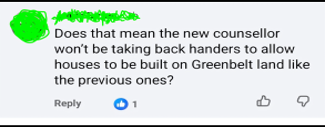
The above was featured on a Heald Green social media site this week, following our new candidate Jamat Ali being announced. Lies and disinformation about planning are often used to invoke bad feeling against us for political reasons.
There is a caveat to all of this in that I’m describing how planning decisions are made at the present time; the situation as is. This all changes from 31 October 2026, with the National Scheme of Delegation, which will standardise the process for deciding planning applications so it is the same for all councils.
To begin with, what is planning?
At the most basic level planning involves setting out a long term vision for places. A decision making process to determine competing uses for spaces. It is the process which gives the opportunity to balance economic, social and environmental needs; whilst undertaking consultation and testing of evidence. It also provides opportunity for issues to be raised and alternatives explored. It is important to us all because planning ultimately delivers change to the areas in which we live and work. When it comes to these places each one of us may have differing ideas of how they should be developed, or shouldn’t. Planning has the very difficult job of balancing these competing views and determining the agreed approach for the benefit of us all.
What informs the planning process?
In the UK we have a “plan led” system of decision making. This means decisions on development applications are guided by official local and national development policies rather than ad-hoc or reactive choices. National policies including the National Planning Policy Framework (NPPF), National Planning Policy Statements and the National Planning Policy Guidance set out the approach. The NPPF is regularly updated, for example in 2024, the idea of “grey belt development” was introduced, to allow development on certain green belt land. This change has led to an influx of development applications in Stockport borough.
The NPPF requires that planning decisions must align with the adopted local plan, unless there are “material considerations” that dictate otherwise – some kind of exceptional circumstance. Stockport Council is currently developing its new local plan, which the councillors and the Ratepayers’ Association Committee have done much work to publicise with residents. Until it is in place decisions must align with the existing equivalent documents the “Core Strategy” from 2011 and the 2006 “Saved Policies of the Stockport Unitary Development Plan Review” which both pre-date the NPPF. Also, decisions must consider any Neighbourhood Plans. More detail on those later.
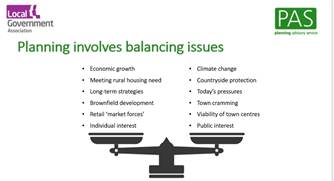
Planning is about balancing competing ideas; the graphic below captures this.
Source: Defensible Decision Making – The Planning Advisory Service
Who makes decisions?
There are 63 councillors on Stockport Council, three to represent each ward. They are voted in at elections for each role every four years. Councillors make decisions on how the council is run – you can read about how they do that in detail here: What are the roles and responsibilities of a councillor? Why so many meetings? – Heald Green Ratepayers. Many responsibilities are delegated to council officers by decisions at council meetings. Council officers are the paid permanent employees of the council; these include experts in each area of work. For example, planning officers will have qualifications such as a degree or post graduate qualification in planning.
In Stockport Council, at present, under the scheme of delegation over 90% of planning applications are delegated to officers to determine. Applications will go to the Planning and Highways Regulatory Committee to decide when:
- They are strategic applications that address larger local issues,
- There are departures from adopted policy, that are recommended for approval, and
- Where applications are referred from Area Committee.
Local councillors can call up applications, for a planning reason, to Area Committee too.
How do councillors make decisions?
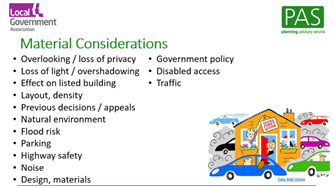
Officers compile the planning report, with a recommendation to approve or refuse. Officers have to critically assess proposals based on the key policies already mentioned and balance the “material considerations,” the planning issues that planning law says are relevant to the application. The council has to ensure its decisions are lawful and stand up to scrutiny. The council, and councillors, do not have a free hand to approve or refuse applications as they alone see fit. Material considerations are the planning factors that are relevant to a proposed development – these are listed below. Also, there are non-material considerations. These are worth noting too. These are things that don’t support a lawful decision so shouldn’t be part of any argument. It’s interesting to note that the strength of opinion for or against an application is not a material consideration – it’s the content of objections, the application of relevant material considerations, that is important rather than the volume.
Source: Defensible Decision Making – The Planning Advisory Service
When it comes to decision making councillors are not expected to be experts in planning. Their role is to read the papers and ask the applicant and the officer to clarify any issues that they do not understand. The advice is VERY CLEAR that councillors have a duty to consider the evidence in the report – and no other information – when they come to their decision. Their role is to listen to the expert views and the comments of the professionals, including the planning officers, who have contributed to the report.
Overturning decisions and going against the advice of officers
Councillors, as part of the committee, can make a different decision to that recommended by officers. However, their decision needs to be justifiable on planning grounds. For example, where the highways engineer advises that the development will not have a severe impact in traffic terms, if a councillor then chooses to overturn this, they need to be able to explain and evidence this, rather than rely on anecdote or personal experience. The reason has to be accurate, related to the development proposal, material considerations and the local plan.
If the application is overturned at area committee, then the councillor will have to defend the council at the appeal hearing. Doing this means the chances of a developer making a successful appeal are higher. The costs will also have to be paid from the delegated budget for the ward if the appeal is successful. Usually planning applications are passed on to Planning and Highways Regulatory Committee further consideration before making the final decision to approve or decline.
Stockport Council has had a number of decisions not to allow large housing developments appealed including The Seashell Trust site, Bredbury Gateway, Mirrlees Fields, Gatley Golf Club and Woodford Garden Village Extension, which the council is currently appealing. With a successful appeal found against it the council can bear substantial costs, and has done so in a number of these cases.
It is also worth noting that some developments can be approved in “outline,” which are approved in principle. This means there is little detail, this is then covered by further applications. For example, the Woodford scheme had 120 subsequent applications covering “reserved matters”. The McDonald’s restaurant at Stanley Green was approved in this way. It can come as a shock to residents at the later stage, when the reserved matter applications come in, as residents may be unaware that a development has already been approved.
Predetermination and bias
Determining planning applications is a quasi judicial process, meaning that it’s like a court. Councillors are required to keep an open mind and consider all the evidence. If a councillor says they will support local residents who are campaigning against a development they would be predetermining the application. Meaning the developer would have a right to challenge the decision. Decisions can be challenged via Judicial Review and the Local Authority Ombudsman. Costs can be awarded against the council for unreasonable behaviour. That is why we have to be neutral about any proposed development in Heald Green ward, and why we always strongly encourage residents to submit their comments direct to the council for a planning application so that they can be included in the process and given due consideration.
Timescales
The council is required by law to decide applications within set time scales, these are eight weeks for a minor application, 13 weeks for a major application, 16 weeks for applications requiring an Environmental Impact Assessment and 10 weeks for new schools. This is why consultations may sometimes happen during holidays, as they cannot be delayed, otherwise the council could be put in special measures.
Why housing developments are approved and the truth about brown envelopes
When it comes to making decisions on housing developments one of factors which trumps pretty much everything else is the five year housing land supply. The council has house building targets set by government. It must be able to demonstrate it has enough sites approved in the pipeline to deliver 1,906 new homes per year, for the next five years. The council is only able to demonstrate a 1.7 year land supply with the dated development plan document it has to refer to at present. This means that developers have a very high chance of winning at appeal. In footballing terms housing developers are “shooting at an open goal” with their applications until the council gets a new local plan in place.
Another factor of importance is that the NPPF has a “presumption in favour of sustainable development.” Which is one of the things that was most surprising to us when we became councillors – the system favours new developments that meet the criteria set out in the NPPF.
Which leads me on to one of the biggest online myths. Councillors receiving brown envelopes. I can categorically say that no developer has ever offered any of us inducements. There are good reasons for this. Firstly, we will always meet developers with a senior council officer present. Secondly, developers really don’t need to offer brown envelopes – the two facts I’ve just mentioned mean that any developer that submits an application that complies with the NPPF has a very high chance of succeeding in Stockport because of its particular situation. If you’re bringing brown envelopes into the conversation then you’re just showing you know absolutely nothing about planning – that is the absolute truth. This is also why we’d encourage residents to engage in scheme designs and developer proposals as developments stand a high chance of being built. Schemes are likely to be better designed when residents engage and suggest improvements.
One of the other local myths, which is aired by those who campaign against us on social media, is that Heald Green ward gets more housing because of political decisions. Which is not the case for all the reasons outlined above, this recent approval of a development on green belt land in Hazel Grove shows this: https://stockport.nub.news – green belt homes approved in Hazel Grove. I know from the emails I am copied in on that there are a number of other controversial schemes in Stockport outside our ward.
The local plan
Stockport’s new local plan is currently in development, with the Regulation 19 publication and consultation underway from now until 8 November 2026 there’s more info in this link: Stockport local plan September 2026 (Regulation 19) consultation – Stockport Council. The local plan is due for submission later in the Autumn and adoption in late 2027. You can read more on our work on this on our website: Local Plan Next Stages – Regulation 19 Consultation – Heald Green Ratepayers
Neighbourhood plans
Some areas in Stockport have neighbourhood plans – Woodford, High Lane, and Marple, which also need to be considered in determining an application. These are usually developed by local communities independently from the council. They set particular local guides, for example on housing, transport or amenities. However, they have to align with the borough wide strategies and these areas still need to support delivery of housing land supply for new housing just like every other area in the borough. They do not allow the neighbourhood area in question to opt out of house building.
Final thoughts
As promised, there’s lots of complexity, even though I’ve tried to keep this as short as possible. As part of the councillor role it’s recognised that we are sometimes required to make difficult and often unpopular decisions. The purpose of this explainer has been to show exactly why that is and what we as councillors have control over and what we don’t.
If you’ve stayed with me and managed to get this far, thank you! Sometimes people don’t want to engage with the complexities, and blame the council, its officers or us. We are going to see more developments proposed and councillors can’t just stop them. Anyone who says otherwise has no idea what they are talking about. There are a lot of bad takes! It’s really not about who shouts the loudest.
And when it comes to brown envelopes, literally the only offer I’ve had this year – humblebrag alert – was from Cadent. This was to look at the broken gas main that closed the A34. No brown envelopes. Nada. Nothing. There never has been in all of my six years as a councillor. Though it was after a surprising 50,000 plus people looked at the social media post about a gas main on the A34 that I realised that people really do want to know the detail about what’s going on in their local area and understand why things happen the way they do. That is why I’ve put this together. I hope you’ve found it of interest, and I’ve succeeded in demystifying planning to some degree.
One last thing to be aware of is that there is planning reform due to be implemented on 31 October 2026, which will bring huge changes to the process. However, we thought it useful to describe the process as is to help residents understand the current system in comparison to the changes that are coming. We will share more details of the way planning decisions will work under the National Scheme of Delegation in due course.
Please note the information contained here is intended to give an informal overview of the planning process, based on our observations from the involvement we’ve had and the training we’ve received as councillors. It is not to be used as official guidance. For any planning matter we would always advise that you engage with officers at Stockport Council and read the information on the council’s website.
Cllr Stuart
October 2026